Now you’re living the dream — working from cafés and bouncing between countries, waking up wherever you want. Here’s the thing nobody mentions in those glossy Instagram posts, though: money runs out quickly.
Hotel charges, co-working spaces, SIM cards, visas, flights, food — it all reveals another whole level of expense. You’re checking your bank balance at 11 PM and wondering how the hell people actually live like this.
Real talk: most long-term nomads aren’t wealthy people. They’re just smart with money.
Digital Nomad Budget Living is not really about earning what you earn, but rather about how smartly you spend it. The hacks in this article come from real nomads who have been on the road for years — not months. They’re pragmatic, quick to implement, and they work.
We’ll take them one at a time.
Hack #1 — Choose Your Base as a Business Decision, Not a Holiday Dream
Stop Going After Cool Cities, Start Going After Low Costs
New nomads make the same mistake over and over again: they go where they want to go, not where their money stretches the longest.
Paris sounds amazing. Bali sounds dreamy. Tokyo feels exciting. But all three would suck a hole in your pocket at different rates.
Seasoned nomads consider their base like a business decision. They ask: Where can I live well, work well, and spend the least?
This is where the idea of geo-arbitrage comes into play. It simply means earning in a solid currency (like USD or EUR) and spending it somewhere those dollars stretch much further.
The Numbers Don’t Lie
Here’s a glimpse of average monthly living expenses for a single nomad in various cities:
| City | Monthly Rent (1BR) | Food (Monthly) | Co-working | Total Est. |
|---|---|---|---|---|
| Chiang Mai, Thailand | $300–$450 | $150–$250 | $80–$120 | $600–$900 |
| Medellín, Colombia | $400–$550 | $180–$280 | $70–$100 | $700–$1,000 |
| Tbilisi, Georgia | $350–$500 | $150–$200 | $60–$90 | $600–$850 |
The gap is staggering. It’s entirely possible for a nomad based in Chiang Mai to live — and eat well — on what someone was paying in rent alone in New York.
How to Make a Smart Move for Your Next Base
Check off this short list before booking anything:
- Internet speed — Check Speedtest results on Nomad List for that city
- Cost index — Use Numbeo.com to compare living costs
- Visa rules — How many days can you stay without doing a visa run?
- Nomad community — Are there Facebook groups or meetups? Community saves money too
- Time zone — Does it overlap with your clients’ working hours?
Budget nomads who get the base selection right can cut their monthly budget by 40–60% — with no loss in quality of life.
Hack #2 — Forget the Hotel, and Become a Medium-Term Housing Pro
Why Hotels Are the Worst Value in Nomad Life
Hotels cater to tourists who stay 2–4 days. You are not a tourist. Hotel rates paid over weeks or months are one of the quickest ways to blow through your budget.
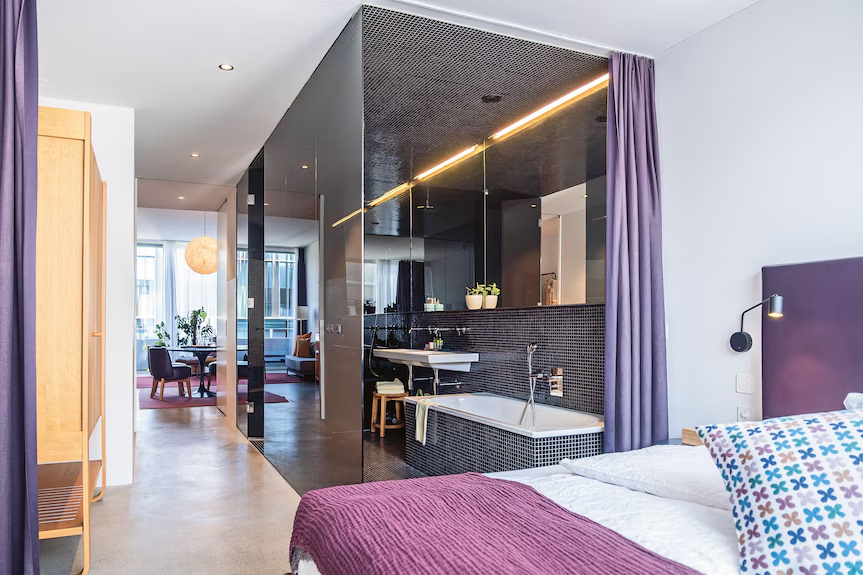
Even “budget” hotels charging $40–$60 a night add up to $1,200–$1,800 a month — for a small room with no kitchen and no real place to work or feel at home.
There’s a much better way.
The Medium-Term Rental Sweet Spot
The magical range is 4–12 weeks. Most landlords and platforms offer meaningful savings for stays within this window.
Here’s where to look:
- Airbnb Monthly Discounts — Most hosts offer 20–50% off monthly bookings. Always message the host directly before booking. Ask if they can offer a better price. Most say yes.
- Facebook Marketplace & Local Groups — Search “[City Name] + apartments for rent” or “[City Name] + expat housing.” You’ll find deals that never appear on major platforms.
- Spotahome, Flatio, and Uniplaces — Platforms that specialise in mid-term furnished rentals. Prices are typically 30–40% less than Airbnb for comparable quality.
- Hostels with Private Rooms — Many hostels now offer private rooms, often with co-working space included. Monthly rates can be surprisingly low, particularly in Southeast Asia and Eastern Europe.
Get Negotiating: The Most Undervalued Budget Weapon
Don’t be shy about negotiating. A landlord would rather have a reliable tenant at a slightly lower price than an empty property for months.
A simple message that works:
“Hello, I’m a remote worker looking to stay for 6–8 weeks. I’m responsible, quiet, and will take good care of the space. Would you consider [X amount] on a monthly rate? I’m happy to pay upfront.”
Offering to pay upfront is a strong card. It lowers risk for the landlord and nearly always leads to a better deal.
Hack #3 — Create a “Nomad Money System” That Works on Autopilot
Where Nomads Lose Money Without Realising It
Here’s something most people don’t consider: the fees you pay just to access your own money abroad can add up to hundreds of dollars a year.
ATM fees. Foreign transaction fees. Bad exchange rates. Wire transfer charges. It eats into your budget month after month, quietly.
The right financial system eliminates most of them automatically.
The 3-Account System That Keeps Hundreds in Your Pocket Each Year
Smart nomads run three financial tools in parallel:
1. A No-Fee Travel Bank Account Look for accounts with no foreign transaction fees and ATM fee reimbursement. Popular options include Charles Schwab (US), Starling Bank (UK), and EQ Bank (Canada). This alone can save real money versus paying 3–5% on every withdrawal.
2. Wise (formerly TransferWise) Wise lets you hold money in multiple currencies and converts at the actual mid-market exchange rate — far better than PayPal or a typical bank for international transfers. Many nomads also use it to receive payments from international clients.
3. A Local Digital Wallet (Where Relevant) In some countries — Thailand (PromptPay), India (UPI), Colombia (Nequi) — local digital wallets offer better rates at markets, shops, and restaurants where foreign cards attract higher prices.
Track Every Expense. Seriously, Every One.
This sounds boring. It isn’t.
Nomads who track their spending consistently find patterns they never noticed before — the daily café latte, the unused streaming subscription, the taxi taken instead of the bus.
Apps like Toshl Finance, Trail Wallet, or a simple Google Sheets template all work well. Set a weekly spending limit and review every Sunday. That single habit has helped thousands of nomads stretch their budgets by 15–25%.
Hack #4 — Don’t Eat Like a Tourist; Eat Like a Local
The Café Culture Trap

Here’s a stealth budget buster that hits almost every nomad: food tourism.
Everything feels new when you arrive in a city. You want to eat at the rooftop restaurant. The Instagrammable brunch spot. The café with great Wi-Fi and $8 smoothie bowls.
Do this every day, and your food budget is gone.
The solution: eat where locals eat — by address, not by postcard.
The “Street Food First” Rule
Street food isn’t just cheap across most of Asia, Latin America, Eastern Europe, and the Middle East — it’s some of the best food you’ll ever eat.
At a street stall in Chiang Mai, a full pad thai costs $1.50. In Medellín, a full lunch at a local cafeteria runs $3–$4. In Istanbul, a hot simit with cheese is under $1.
Compare that to the tourist café version at $10–$15, and the math is obvious.
Tips for Smart Grocery Shopping as a Nomad
Always rent a place with a kitchen — even a small one. Cooking 30–50% of your meals at home is one of the biggest budget wins in nomad life.
Follow these rules when grocery shopping:
- Buy local produce, not imported goods. Imported peanut butter can cost 4x the local alternative.
- Shop at local markets, not expat supermarkets. In Bali, Carrefour is twice the cost of the local pasar (market).
- Cook in batches. Rice and vegetables for 2–3 days takes about half an hour and saves hours of spending.
The 80/20 Food Rule for Nomads
Eat 80% of your meals from the cheapest options — street food, home-cooked, or local spots. Spend the other 20% on experiences: a special dinner, a local cooking class, or one rooftop meal a month.
This way you enjoy food culture without wrecking your budget.
Hack #5 — Work Smarter on the Go: Ditch the Co-Working Fees While Staying Productive
Co-Working Spaces Are Fantastic — Just Not Every Day
Co-working spaces are a nomad staple. Internet, a desk, coffee, community. They’re great.
They’re also $100–$300 per month — and that’s before daily drop-in passes at $10–$25 each.
If you only need a co-working space three times a week, why pay for thirty?
The Hybrid Work Setup That Halves Your Costs
The smartest nomads use a hybrid approach:
| Location | Cost | Best For |
|---|---|---|
| Home / apartment | Free | Deep focus work, calls, writing |
| Café with Wi-Fi | $2–$5 (coffee) | Short tasks, lighter work |
| Co-working space | $10–$20 (day pass) | Important calls, fast internet, networking |
| Library or free space | Free | Reading, planning, light tasks |
By combining these strategically, you get the benefits of a co-working space without the full monthly cost.
Test Internet Before You Commit
For nomads, internet reliability is non-negotiable. Slow or unstable internet kills productivity — and money when deadlines are missed.
Before booking any accommodation:
- Ask the host for a screenshot of a speed test (minimum 25 Mbps download for smooth video calls)
- Search reviews specifically mentioning internet speed
- Test the connection immediately upon arrival using Fast.com or Speedtest.net
- Always carry a backup — a local SIM with a data plan costs $10–$20 in most countries and can be a lifesaver
Your Lean “Nomad Productivity Stack” — Under $10/Month
You don’t need expensive tools. Here’s a lean, low-cost setup:
- Google Workspace (free) — Docs, Sheets, Drive, Gmail
- Notion (free) — Project management, notes, planning
- Clockify (free) — Time tracking for freelancers
- Zoom (free tier) — Client calls up to 40 minutes
- NordVPN or Mullvad (~$4–$6/month) — Protection on public Wi-Fi
Total monthly cost: under $10. That’s your entire productivity stack.
Making It All Work: Your 30-Day Budget Reset Plan
Whether you’re starting from scratch or just want to reboot your finances, here’s a simple 30-day action plan:
Week 1 — Audit and Plan
- Break down all monthly outgoings and categorise them
- Identify your top 3 money leaks
- Research two or three cheaper cities that fit your lifestyle
Week 2 — Create Your Money System
- Open a no-fee travel bank account
- Set up Wise for transfers and payments
- Download a budget tracking app and log every expense
Week 3 — Housing and Food Optimisation
- Contact 5 landlords directly about monthly rates
- Find a local market and street food spot
- Cook at least 3 meals at home this week
Week 4 — Uplift Your Work Environment
- Track actual hours spent in co-working versus hours needed
- Transition to a hybrid work model if appropriate
- Audit your subscriptions — cancel what you don’t use
At the end of 30 days, most nomads who stick to this plan reduce their expenses by 20–35% — and don’t feel like they’re cutting back at all.
FAQs: Digital Nomad Budget Living
Q: How much money do I actually need to live as a digital nomad? A: It depends on where you go, but many nomads in Southeast Asia or Eastern Europe live comfortably on $1,000–$1,500 a month. In Latin America, $1,200–$1,800 is comfortable. Western Europe typically requires $2,500+. A 3-month savings buffer before you begin is a solid safety net.
Q: Is it cheaper to stay in one place or keep travelling? A: It’s almost always cheaper to stay somewhere for 1–3 months. Frequent travel means frequent flights, last-minute bookings, and tourist prices. The most experienced nomads “slow travel” — moving 4–6 times a year, not every week.
Q: What do nomads do about health insurance on a budget? A: Plans like SafetyWing start at around $45–$60 per month and are popular for basic coverage. For more comprehensive coverage, nomads often use World Nomads or insurance from their home country. Get covered — one hospital admission without insurance can erase months of savings.
Q: Can foreigners actually negotiate rent? A: Yes, absolutely. Outside Western Europe and North America, negotiation is the norm. The strongest card you can play is offering to pay upfront for a longer stay. Be friendly, be straightforward, and don’t fear a no — there’s always another listing.
Q: What’s the single biggest money mistake new digital nomads make? A: Treating every city like a holiday. When you’re on vacation, you don’t think twice about splashing out. But that tourist mentality wrecks a long-term nomad budget. Shifting from “vacation mode” to “resident mode” — shopping local, cooking occasionally, using public transit — is the single most significant financial upgrade a new nomad can make.
Q: Should nomads bother chasing credit card points? A: If you’re already spending anyway, yes. Cards like Chase Sapphire (US) or Amex (various countries) let you earn points on normal purchases, redeemable for flights. But never spend more just to earn points. The math only works if you’re disciplined.
Final Thoughts: Spending Less Means Living More
Living on a digital nomad budget is not about being stingy. It’s about being intentional.
Every dollar you avoid wasting on overpriced hotels, tourist restaurants, or unnecessary fees is a dollar that buys you more time — more weeks on the road, more trips made possible, more breathing room when a client goes quiet.
The five hacks in this article — smart base selection, mastering mid-term rentals, a solid money system, eating local, and working anywhere — are not secrets. They’re habits. And habits are formed one choice at a time.
This week, focus on just one hack. Just one. See how it feels. Then add another next week.
The nomads who last aren’t those who earn the most. They’re the ones who learned how to make every dollar work harder than they do.