It seems expensive to live and work abroad. But here is the reality — thousands of people do it every month on less than $1,500. Some even manage on $800.
The secret isn’t sacrifice. It’s strategy.
A digital nomad budget is not about removing all the fun. It’s about spending wisely, making the right choices and understanding what costs you can manage. Whether you’re new to the game of traveling with a remote job or are already hopping between countries, these 10 tips will ensure that you can stretch every dollar even further.
Let’s break it all down.
1. Select Countries Where Your Dollar Really Goes Far
The largest single expense in your monthly budget? Location.
Not your coffee habit. Not your Netflix subscription. Where you live makes all the difference — rent, food, transport and healthcare, not to mention lifestyle.
A $1,500/month budget seems tight in Amsterdam but abundant in Chiang Mai or Medellín. The right country is your first and most potent budget decision.
Most-value countries for digital nomads in 2025
Here is a quick cost comparison for solo digital nomads including rent, food, transport and coworking:
Southeast Asia, Eastern Europe and Latin America have the best bang for your buck. When planning your digital nomad budget, start by seeking out destinations — not apps or gear.
2. Zero In on Long-Term Rentals to Slice Housing Expenses in Half
Housing is your biggest expense — which makes it also your greatest chance to save.
Nomads tend to book short-term, so they end up overpaying. An Airbnb in Bali for a week can run $600. That same space, booked directly for one month? Often $400–$550.
How to secure the best rental deals
Step 1:Book for 5–7 nights on Airbnb or Booking.com to set up a base upon arrival.
Step 2:In those initial days, walk the neighborhood. Look for “For Rent” signs. Ask at cafés, hostels or coworking spaces about local landlords.
Step 3:Negotiate directly. Nomads who pay 1–3 months upfront are landlords’ favorites. You can frequently take 20–30% off the asking price simply by making that offer.
Try these platforms directly: Facebook Marketplace, local expat Facebook groups, Idealista (Europe), HipFlat (Asia) and Properati (Latin America).
To maintain a good digital nomad budget, keep however much you pay for rent to 30% of your monthly income — or less.
3. Cook More, Eat Out Smart
Food is where many nomads quietly blow their budget.
At first, eating out for every meal seems easy and cheap — especially in Southeast Asia when a bowl of noodles can be $1.50. But meals out every day add up quickly.
The 70/30 rule for food
A loose guideline: prepare 70% of your meals, dine out 30%.
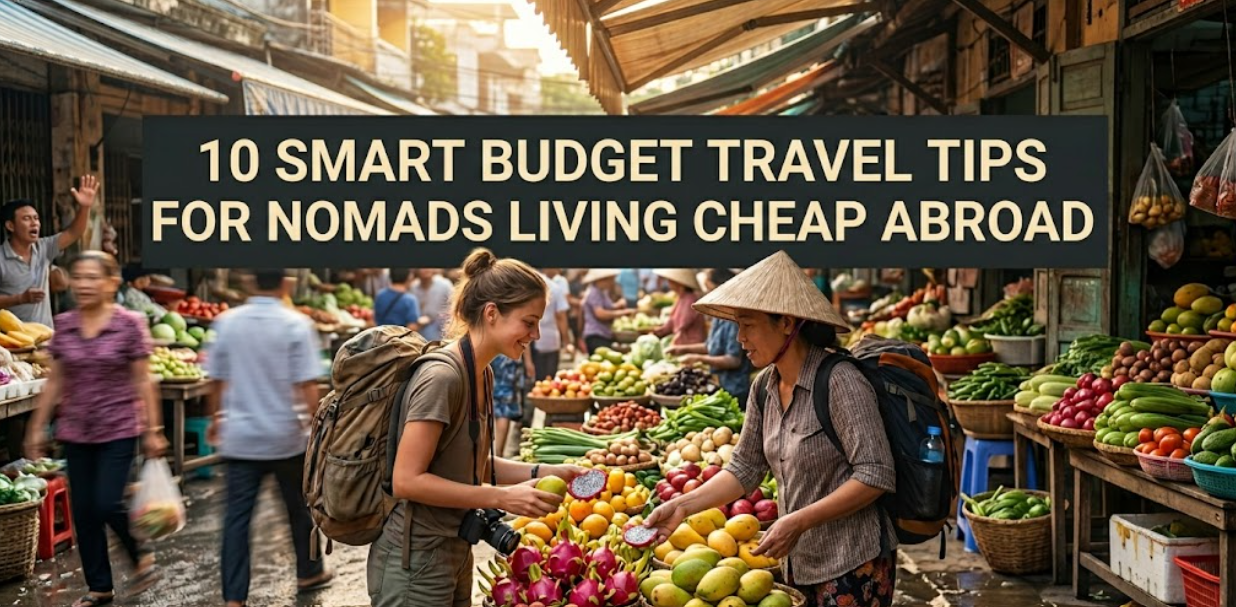
This isn’t about eating sad salads in your apartment. It means shopping at local markets for groceries (much cheaper than expat supermarkets), cooking simple meals and reserving restaurant outings for the good ones.
Where to shop cheap:
- Local wet markets and street stalls
- Walmart, Lidl, Aldi and similar discount supermarkets
- Pasar (traditional markets) in Indonesia and Malaysia
- Mercados and tianguis in Mexico and Colombia
Have your heaviest meal at lunch. In many countries a full set lunch at a local restaurant is 40–50% cheaper than dinner.
One of the no-brainer wins in your digital nomad budget is to stop eating every single meal like a tourist.
4. Coworking Options That Are Free or Low-Cost
Coworking spaces are great — but they’re not always necessary.
Popular nomad cities have $80–$200/month coworking passes. That’s a sizeable chunk of a thrifty digital nomad budget.
Places to work for free (or cheap)
- Cafés with decent Wi-Fi: Order a coffee or two and you have yourself an office. You could pay $3–5 and spend 3–4 hours. These spots abound in many nomad-friendly cities.
- Libraries: Many cities — particularly in Europe and Southeast Asia — have free libraries with speedy internet and quiet nooks. Totally underused by nomads.
- Hotel lobbies: Many hotel lobbies offer open seating, air-con and decent Wi-Fi even if you’re not a guest. Just dress the part.
- Hostel common areas: Many hostels attract working travelers and have communal desks. Some even offer day passes.
Save your coworking budget for the days you desperately need a professional setting — a video call, a long focused sprint or a networking event.
5. Travel Slow to Spend Less

Moving around feels exciting. But it’s expensive.
Whenever you cross a border, you pay for transportation, a new SIM card, the first night’s lodging in a new city and a few restaurant meals while you find your feet.
Why slower travel saves a lot
If you stay in one place for 1–3 months rather than hopping every 2 weeks, you can easily save $200–$400/month. Here’s why slow travel is good for your digital nomad budget:
- You get a better deal on rent — landlords favor longer stays
- You learn where the cheap local spots are instead of falling into tourist traps
- You cook more, because you have a kitchen you can actually use
- You waste less time (and money) on transit logistics
- You avoid peak-price last-minute bookings
Here’s a perspective shift: the less you move, the more you save. The veteran nomads now base themselves in a destination for 2–6 months.
6. Open the Proper Bank Accounts and Cards
Banking and payment fees quietly eat away at your budget.
ATM withdrawal fees, foreign transaction fees and poor exchange rates can cost you $30–$80 a month. That’s money gone for nothing.
Banking tips for nomads
- Use fee-free cards such as Wise or Revolut for everyday spending
- Always withdraw larger amounts less frequently — three $200 withdrawals beats six $100 ones in fees
- Never use airport currency exchange booths — their rates are typically 5–10% worse than ATMs or bank transfers
7. Get Local SIM Cards Instead of Roaming
Roaming with your home carrier abroad is one of the fastest ways to overpay.
In most nomad destinations, a local SIM costs $5–$15 and covers a full month of data. Compare that with international roaming plans that charge $10–$15 per day.
A guide to phone and internet on the road
- Buy a local SIM on arrival. Available at most airports and convenience stores. In Thailand, data costs around $8/month. In Colombia, you can get 20GB or more for $10–$12.
- Get an eSIM for the first few days. Services such as Airalo or Holafly sell digital SIM cards you activate before your plane lands. They cost more than a local SIM but are handy for arrival day.
- Keep your home SIM active for texts from banks. A handful of banks send verification codes to your home number. A low-cost roaming plan for texts — but not data — keeps this ticking over without breaking the bank.
Typically, the internet at accommodations is adequate for work. But if you want a backup, a local data SIM can serve as a hotspot.
8. Book Travel Smart to Avoid Unnecessary Fees
Transportation is a real expense in every digital nomad budget. But there are tricks for keeping it low.
Flights: book smart, not last minute
- Search Google Flights and create price alerts
- Flying on Tuesdays or Wednesdays is nearly always cheaper
- Avoid flying in and out of the same hub — open-jaw tickets (fly into one city, out of another) often save $100–$200
- Use budget airlines: AirAsia and Scoot in Southeast Asia; Ryanair and Wizz Air in Europe; JetSMART and VivaAerobus in Latin America. Book early — their fares go up quickly.
- Use trains and buses for shorter distances. A $15 overnight bus beats a $90 flight when you factor in no airport transfers, no 2-hour check-in and a free night of accommodation.
Ground transport in your destination
- Use local ride apps: Grab in Southeast Asia, inDrive in Latin America and Eastern Europe, Bolt in Europe and Africa
- Rent a scooter in cities where it makes sense (Bali, Chiang Mai, Hoi An)
- Walk more — many nomad neighborhoods are small and walkable
- If staying a month or longer, buy a monthly public transit pass
Transportation should take up no more than 10–15% of your monthly digital nomad budget.
9. Figure Out Health Insurance Before You Leave
This one isn’t merely a budget tip — it’s a survival tip.
Medical emergencies abroad can be devastating without coverage. In the US, a single hospital stay costs more than $10,000. In less expensive countries, a surgery or severe illness can still run $3,000–$5,000.
Health insurance options for nomads
- SafetyWing is the top pick for budget nomads. Plans can run as low as $45–$60/month depending on your age. Coverage isn’t 100% comprehensive but it’s solid for emergencies in most countries.
- World Nomads has broader coverage — great for adventure travelers or those doing riskier activities. Costs more: usually $100–$150/month.
- Local insurance for long stays. If you plan to stay in a country like Thailand, Georgia or Mexico for 3+ months, local health insurance plans can cover you for as little as $30–$50/month with excellent care.
Skipping insurance to save money is a false economy. A single bad week can erase a year’s worth of careful planning.
10. Build Your Budget Tracking Habit
You can’t improve what you can’t see.
Most nomads who run out of money don’t have a spending problem — they have a visibility problem. They don’t know where the cash is going until it’s long gone.
How to keep budgeting simple
- Option 1 — Spreadsheet: Create a basic Google Sheet with columns for date, category (rent, food, transport, fun), amount and currency. Update it every evening. Takes 3 minutes.
- Option 2 — App: Trail Wallet, Spending Tracker or YNAB let you set budgets by category; some track in multiple currencies.
- Option 3 — Wise or Revolut integrated tracking: Both apps automatically classify your expenditures. Use them for most purchases and you get a free spending overview every month.
Check in on Sundays. See if any category overran. Ask yourself why. Change one thing the following week. Small adjustments over time add up to a huge difference.
Bonus: Maximize Rewards With Travel Credit Cards
This tip is particularly powerful for nomads earning in USD, GBP or EUR.
The right travel credit card can earn you free flights, free hotel nights, lounge access and travel insurance — all from what you already spend. You’re already spending $1,200/month — you might as well earn something back.
Cards worth considering
- Chase Sapphire Preferred (US) — Solid travel rewards, trip cancellation insurance, no foreign transaction fees.
- American Express Platinum Worldwide (US/UK) — High annual fee, but it nearly pays for itself with lounge access and hotel credits.
- Barclays Avios Rewards (UK) — Best for earning Avios points for flights on British Airways and partners.
- Fee-free options: The Wise card and Revolut card aren’t rewards cards, but they deliver zero fees — which is savings of a different kind.
The rule is simple: never carry a balance. It’s free money as long as you pay off the card each month. If you carry debt, the interest cancels out all the rewards and then some.
The Budget Mindset That Makes You a Digital Nomad
Each of the ten tips above is tactical. But the greatest change is mental.
New nomads often compare themselves to the highlight reels on Instagram. Those people are most likely sponsored, in debt, or only sharing their best moments. Real nomad life on a budget looks like this: comfortable apartments, decent food, friends in the local community and meaningful work — with no financial stress.
Cheap vs. smart
Being cheap is different from being strategic.
Being cheap is skipping travel insurance to squeeze $50 out of the budget — then spending $3,000 on a hospital visit. It means picking the cheapest apartment in a sketchy neighborhood and paying more for ride-shares because you don’t feel safe walking. It means booking the barebones cheapest flight with three layovers and arriving exhausted for a major client call.
Being strategic means:
- Spending where it saves you hassle — insurance, quality accommodation
- Cutting what doesn’t matter — big-name brands, touristy restaurants, daily Starbucks
- Investing in tools that increase your earning — faster internet, good equipment
- Building at least a 2–3 month emergency fund
A good digital nomad budget is not about living small. It’s about spending with intention so you can live large — sustainably.
Frequently Asked Questions on Living Cheap as a Digital Nomad
How much money do I need to begin my life as a digital nomad?
As a baseline, most full-time nomads get started on $1,500–$2,000/month depending on destination. You can live well on $800–$1,200/month in Southeast Asia and Eastern Europe. Western Europe and parts of Latin America are more expensive ($1,500–$2,500/month on average).
Which country has the best cost of living for digital nomads in 2025?
Chiang Mai, Thailand is consistently ranked the most affordable destination. Other favorites include Tbilisi (Georgia), Ho Chi Minh City (Vietnam) and Medellín (Colombia). All offer fast internet, healthy nomad communities and low costs.
Can you be a digital nomad on $1,000/month?
Yes — but location matters enormously. $1,000/month in Southeast Asia (Thailand, Vietnam, Indonesia) covers rent, food, transport and coworking with a little left over. In most of Europe or Latin America, you’d need to be very disciplined or live in less-traveled secondary cities.
What do my taxes look like as a digital nomad?
Whether you owe tax depends on your home country and how long you stay in each destination. Many nomads use the “183-day rule” as a guideline — spending fewer than 183 days in any country may free you from tax residency there. Seek professional advice from a tax expert familiar with expats. Portugal, Georgia and Paraguay have particularly favorable digital nomad tax regimes.
How do I create my first digital nomad budget?
Start with the three main expense categories: housing, food and transport. These account for 65–75% of your monthly spend on average. Nail those first. Then examine banking fees, subscriptions and discretionary spending. Create a simple spreadsheet and track everything for at least 90 days before declaring you know your true costs.
How can nomads book flights for less?
Use Google Flights and set up price alerts. Travel on Tuesdays and Wednesdays. Book 3–6 weeks in advance for short-haul and 6–12 weeks for long-haul. Use budget airlines for shorter routes. And embrace slow travel — the less you move, the fewer flights you need.
Do I need travel insurance if I already have a credit card with travel protection?
Credit card travel protection typically covers trip cancellation and lost luggage — not medical emergencies. You still need a separate health insurance plan. SafetyWing is the most well-known budget nomad option, starting at around $45–$60/month.
Focus on Building a Life, Not Just Tracking the Numbers
A digital nomad budget is not a cage. It’s a framework that lets you roam.
When you know your numbers, choose the right locations, negotiate your rent, eat smart and avoid common money traps — you stop sweating every dollar. And once you stop worrying about money, you can focus on what really matters: your work, your adventures and your life.
Try one or two tips from this list. Apply them this week. Then add the others as you go.
The point is not to spend as little as possible. The point is to spend so judiciously that the life you want becomes fully attainable — and then some.