Sounds like a dream, right? The upside is that it’s more achievable than ever. The not-so-great news? Most people unfortunately begin with the wrong setup for their digital nomad lifestyle, quickly spending much more money than anticipated.
The secret isn’t making more money (although it helps). The trick is to do things smart from day one.
This guide gets into the nitty-gritty of 5 fast digital nomad budget travel tricks that seasoned remote workers swear by. These are not vague adages like “spend less.” These are tangible steps you can take this week — whether you’re mapping out your first journey, or looking to patch up a leaking budget on the road.
Let’s get into it.
Trick #1: Establish a “Nomad Stack” — The Right Equipment, Not the Most
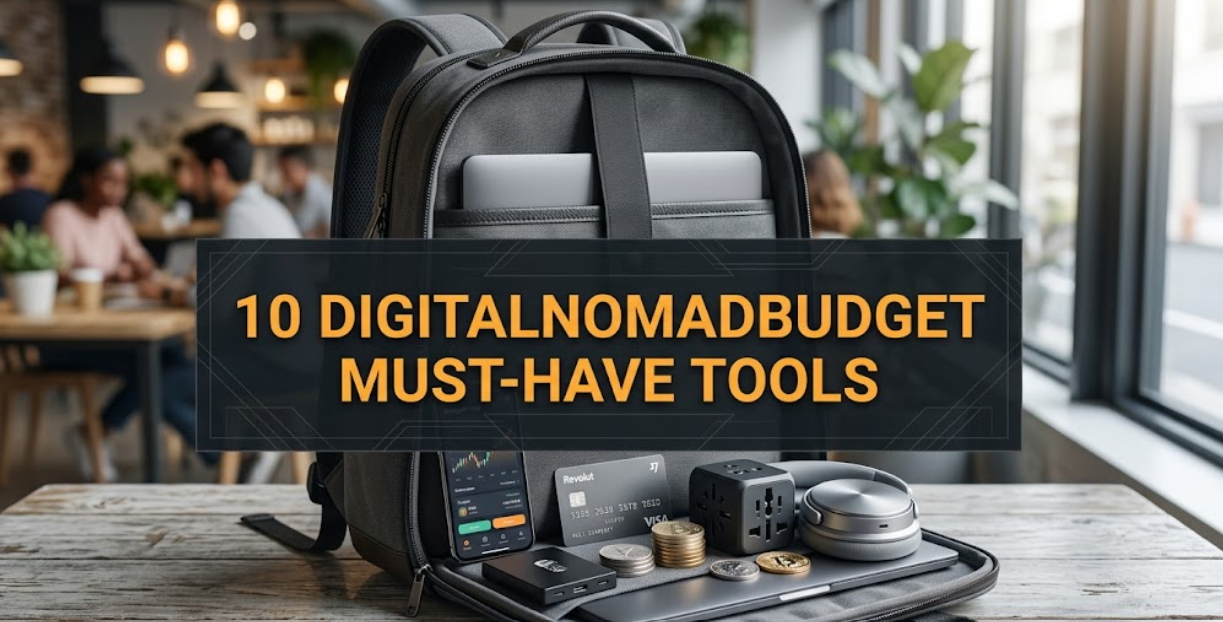
Overpacking — especially tech — is one of the biggest budget mistakes that new digital nomads make. They purchase a new laptop, a backup laptop, three monitors and every single travel gadget on Amazon. Then they pay for excess weight or to ship things home.
The most money-saving digital nomad budget travel configuration of gear is lean and mission-focused — not the most expensive.
What Makes a Smart Nomad Stack?
Your gear has a single task: allow you to work reliably from anywhere. Here’s what that means in practice:
The Core Three:
- An inexpensive laptop (ideally under 1.5kg)
- One good universal travel adapter (not five cheap ones)
- Noise-cancelling earbuds or headphones to concentrate in noisy cafés
That’s all most nomads need when starting out. The rest can be rented, borrowed or purchased locally as needed.
Buy Once, Buy Right
This is especially true for:
- Laptop bags — The zipper breaks in a downpour and your entire day is ruined
- Power banks — The cheap ones stop charging in severe heat
- Travel locks — Budget ones can be cut in seconds
Spend once on the essentials. Save on everything else.
Avoid the “Just in Case” Stuff
The majority of nomads have a graveyard of gear that they purchased “just in case.” A portable printer. A second monitor. A full camera kit. These things sit gathering dust, draining your budget. If you really need something for a particular project, rent it or work in a co-working space that has it.
Rule of thumb: If you haven’t needed it in your first two weeks on the road, ship it home.
Trick #2: Secure a Low-Cost Internet Strategy Before You Get There
Connectivity is your lifeline. Lose it, and you lose income. But shelling out for roaming data or sluggish hostel Wi-Fi is one of the quickest ways to hemorrhage cash on the road.

The smart move? Setting up your digital nomad budget travel internet before arriving in a new country — not after.
The Three-Layer Internet System
Veteran nomads do not depend on a single connection. They use layers:
Layer 1 — Local SIM card. Purchase one at the airport or a local shop in your first hour after landing. Monthly data SIMs in most of Southeast Asia, South America, and Eastern Europe run $5–$15 per month, giving you fast 4G/5G that beats hotel Wi-Fi 90% of the time.
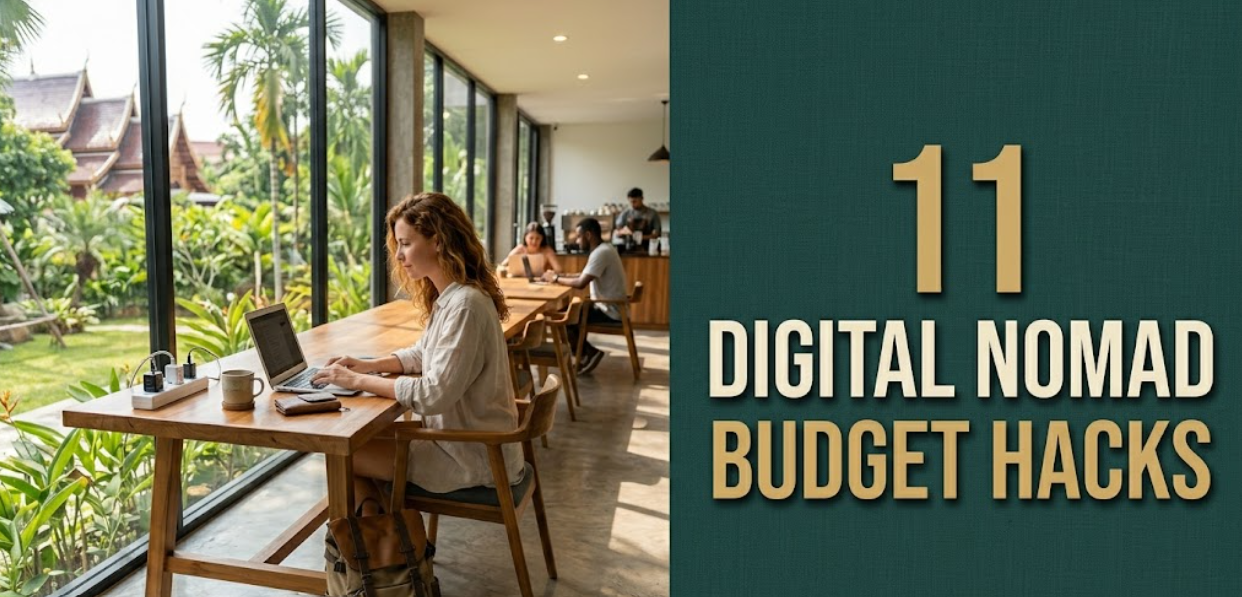
Layer 2 — Co-working space membership. On serious work days, a day pass or monthly membership at a co-working space guarantees you high-speed internet, quiet, and often free caffeine. In budget destinations, many spaces are under $10/day.
Layer 3 — Portable hotspot or eSIM backup. Apps such as Airalo or Holafly allow you to buy eSIM data for most countries in a matter of minutes. Keep a small data plan active as your emergency backup when Layer 1 or 2 is down.
What to Check Before Booking Accommodation
Always — always — check internet speed before committing to accommodation. Use these steps:
- Find the listing’s exact address
- Ask the host to tell you their internet speed in Mb/s
- Look for reviews that specifically mention Wi-Fi
- Use tools like Speedtest.net to test on arrival
Working from home and video calls requires at least 10 Mbps upload. Anything lower and you’ll be dropping calls constantly.
Trick #3: Geo-Arbitrage Is Your Budget Secret Weapon
This is the hack that sets budget-savvy digital nomads apart from everyone else. Geo-arbitrage is simply earning in a strong currency but spending where the currency is weaker.
If you get paid in USD or EUR and live in lower-cost-of-living countries, your dollar goes a very long way. This isn’t cheating. It’s just smart math.
Where Does Geo-Arbitrage Work Best?
You want the Goldilocks zone — countries where you can truly live comfortably on $1,000–$2,000 a month — rent + food + transport + co-working + fun.
How to Establish Your Geo-Arbitrage Strategy
Step 1: Know your income floor. Determine your monthly take-home (or minimum freelance income) before deciding where to base yourself. Allow 20% extra for slower months.
Step 2: Identify places where your monthly expenses max out at 50–60% of your earnings. This gives you breathing room to save, travel and cover the unexpected.
Step 3: Plan a slow travel schedule. Moving every other week is expensive. Staying one to three months in each place slashes your travel costs — flights and visa fees, yes — but also the hidden costs of settling into a new place every time.
Step 4: Stack discounts. Monthly rentals are generally 30–50% cheaper than nightly booking sites. Add a local SIM, home-cooked meals and public transport — and you’re frequently hitting under-budget months.
Trick #4: Create a Nomad-Proof Financial System in Under a Weekend
Banking and money management is where most new nomads waste hundreds of dollars a year — in ATM fees, foreign transaction fees or poor exchange rates.

Setting this up properly takes one focused weekend. The rest is autopilot from there.
The Three Accounts You Need
Account 1 — International bank account with no fees. Alternatives to traditional banks — Wise, Revolut, Charles Schwab for US nomads — allow you to hold and spend several currencies without conversion fees. Wise in particular is very good for freelancers who get paid in multiple currencies.
Account 2 — Local account or cash buffer. In some countries, credit cards aren’t widely accepted. Have a cash buffer (typically $100–$200) converted to local currency when you land. Exchange at official kiosks, not airport ones — the difference can be 10–15%.
Account 3 — A home savings account. Keep your emergency fund (3–6 months of living costs) in a high-yield savings account in your home country. Leave it alone unless there’s a real emergency.
Watch These Fee Traps
| Fee | Amount | How to Avoid |
|---|---|---|
| ATM foreign fees | $3–$7 per withdrawal | Use Schwab or Revolut |
| Dynamic Currency Conversion | 3–7% on top | Always pay in local currency |
| International wire fees | $15–$35 per transfer | Use Wise for transfers |
| Inactivity fees | $5–$15/month | Keep accounts active |
Get Paid in the Right Currency
If you work freelance, bill clients in USD or EUR — the two most widely accepted currencies worldwide. Use tools such as Wise Business, PayPal Business or Stripe to accept payments internationally and convert at competitive rates.
Trick #5: Book Slowly and Stack Deals
The last trick is as much a mindset shift as a strategy. The single biggest lever in a digital nomad budget travel setup is slow travel — renting places for weeks or months instead of days.
The reason: virtually every cost on the road is higher for short-stay travellers. Accommodation, transport, local knowledge — even food — become cheaper the longer you stay in one place.
Why Slow Travel Saves You More Than You Realise
When you stay somewhere for a month, you’re no longer a tourist — you’re essentially local. That shift saves money across every category:
- You cook more because you have a kitchen
- You eat at the local market, not the tourist restaurant
- You avoid tourist transport and take the local bus
- You get an apartment monthly rate instead of a nightly hotel price
- You skip the tourist spendathon of “do everything in 3 days”
The math adds up fast. A week at a tourist hostel could run $350. A shared apartment for a full month in the same city? Often $400–$600 total — four times longer for less than double the price.
How to Stack Travel Deals Like an Expert
Flights: Set Google Flights price alerts. For international routes, book 6–8 weeks in advance. Fly into secondary airports when you can.
Accommodation: Use Airbnb or Booking.com for the first two nights while you scout around, then negotiate monthly rates directly with landlords — often 30–40% cheaper.
Food budget hacks:
- Eat breakfast and lunch locally (typically $1–$3 per meal in budget destinations)
- Cook dinner at your accommodation 3–4 times per week
- Hunt for the local “set menu” lunch — almost every culture has one, and it’s the best value meal of the day
Co-working deals: Many co-working spaces offer unlimited monthly memberships in the $80–$150 range in budget destinations. That’s typically cheaper than 10 separate day passes, and you get a reliable workspace, fast internet and community.
Slow Travel Route Planning
The ideal 12-month nomad route mixes budget countries with occasional splurges. A well-structured plan might look like this:
- 6–7 months in cheap destinations (Southeast Asia, Eastern Europe, Latin America)
- 2–3 months in mid-range destinations (Portugal, Mexico, Morocco)
- 1–2 months in higher-cost destinations as a splurge or for specific purposes
- 1 month buffer for flights, travel days and unexpected stays
This keeps your yearly average cost low while allowing for variety and the experiences that make the lifestyle worthwhile.
Bringing It All Together: The Digital Nomad Budget Travel Checklist
Before you go — or to correct your current setup — check off this list:
| Area | Action | Cost Estimate |
|---|---|---|
| Gear | Buy lean, quality essentials only | $800–$1,500 one-time |
| Internet | Local SIM + co-working + eSIM backup | $30–$80/month |
| Banking | Wise + Revolut + home savings | Free to set up |
| Destination | Choose a geo-arbitrage hotspot | Saves $1,500–$3,000/yr |
| Travel style | Commit to slow travel (1–3 months/place) | Saves 30–50% on accommodation |
Digital Nomad Budget Travel FAQ
Q: How much money do I need to become a digital nomad? Most people can begin comfortably with a buffer of $5,000–$10,000 in savings and a steady income of at least $1,500–$2,000 per month. In budget destinations, that income range permits a comfortable lifestyle.
Q: What is the cheapest country to go digital nomad? Thailand (especially Chiang Mai), Georgia (Tbilisi), Vietnam and Colombia (Medellín) are perennial favourites. Monthly expenses including accommodation, food, co-working and transport often come in at $800–$1,200.
Q: Should a digital nomad purchase travel insurance? Yes — absolutely. Medical emergencies overseas can run tens of thousands of dollars without coverage. SafetyWing and World Nomads are digital nomad favourites, with SafetyWing being the budget option at around $40–$50/month.
Q: How can digital nomads stay tax-compliant? It depends on your country of origin’s tax law. Most people maintain tax residency in their home country until they formally establish tax residency elsewhere. Speak to an accountant who specialises in expat or nomad tax situations before making any major moves.
Q: What’s the best way to find budget accommodation as a digital nomad? Start with Airbnb or Booking.com for your first few nights, then check Facebook groups (search “[City Name] Expats” or “[City Name] Digital Nomads”) for direct landlord listings. Sites like Furnished Finder, Spotahome and Flatio specialise in monthly furnished rentals.
Q: How do I stay secure when working from cafés and public Wi-Fi? Public Wi-Fi carries security risks. Always use a reputable VPN when working from cafés, airports or any shared network — Mullvad and ProtonVPN are both popular choices. Never access sensitive accounts without one.
Q: How do I avoid burnout as a digital nomad? Burnout hits when the novelty wears off and you lack a solid routine. Slow travel helps enormously. Having a co-working space, set working hours and local social ties can ground you when everything else around you is constantly changing.
The Bottom Line
The budget travel setup for a digital nomad isn’t complicated — but it is deliberate. Most people aren’t working from the wrong countries or earning too little. They’re simply set up inefficiently: wrong gear, wrong banking, moving around too much, no internet backup plan.
The five tricks detailed in this guide — a lean gear stack, a layered internet system, geo-arbitrage, a nomad-proof financial setup and slow travel — all work like cogs in a machine. Each one saves you something. Together, they can save you $500–$1,500 a month compared to the “figure it out as you go” approach.
Pick one trick to try this week. Fix your banking. Use the cost breakdowns to research your next destination. Download Airalo. The momentum builds quickly — and so does your confidence that this lifestyle is genuinely, sustainably possible.